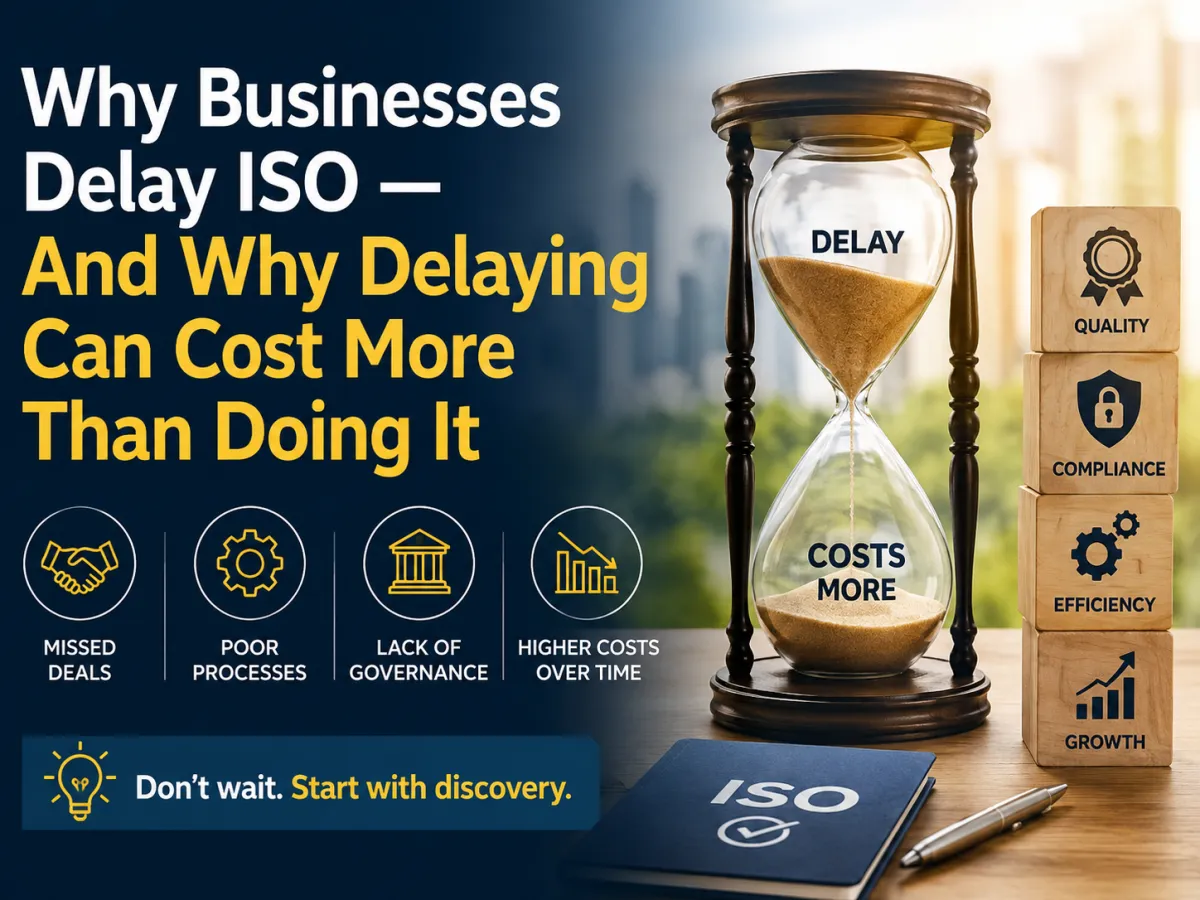
Why Businesses Delay ISO ... And Why Delaying Can Cost More Than Doing It
Why Businesses Delay ISO ... And Why Delaying Can Cost More Than Doing It
Many business owners have heard of ISO.
But the reaction is often the same.
“We are not big enough yet.”
“It will be too expensive.”
“There will be too much paperwork.”
“We will look at it when a client asks for it.”
Sound familiar?
These are common reasons businesses delay ISO.
But there is another question worth asking.
What is the cost of waiting?
The Cost You Don’t See
The cost of ISO is easy to see - Consulting. Documentation. Systems. Certification.
The cost of not having structured processes is harder to see. It appears in different places.
A tender you cannot participate in.
A large customer who chooses a competitor.
A mistake that keeps happening.
A process that only one employee understands.
A business owner who has to approve everything.
A compliance issue that could have been prevented.
Individually, these may look small. Together, they can become expensive.
Myth: ISO Is Only About Certification ...
This is one of the biggest misconceptions. ISO does not have to start with certification. A business can first become ISO-aligned.
That means using recognised ISO principles to improve how the business operates.
Clear policies & defined processes.
Documented responsibilities.
Better controls.
Risk management.
Continuous improvement.
Certification can come later when there is a commercial reason for it. For example, a tender requirement or a major client's expectation.
Poor Processes Have a Cost ...
Think about your own business.
Are the same mistakes happening repeatedly?
Are important processes sitting inside people's heads?
Would the business operate smoothly if a key employee left tomorrow?
Do different employees perform the same task differently?
If the answer is yes, the business may already be paying for poor processes.
ISO 9001, for example, focuses on creating clear, repeatable and controlled processes.
The objective is not paperwork ... the objective is consistency.
Governance Becomes More Important as You Grow ...
A small business can often operate informally. Everyone knows everyone. Problems are solved through conversations. But what happens when you grow?
More employees.
More locations.
More customers & suppliers.
More information.
More risk.
Informal management becomes harder. ISO-aligned processes help introduce structure and accountability. That can make growth easier to manage.
ISO Can Also Open Doors
For some businesses, ISO certification becomes commercially important.
Government tenders may ask for it.
Enterprise customers may prefer certified suppliers.
Customers handling sensitive information may expect stronger information security controls.
In these situations, waiting until the opportunity arrives can be too late. ISO readiness takes time.
Processes need to be implemented and followed before certification.
So, Where Should You Start?
You don't need to jump straight into certification. Start with discovery.
Understand your current processes.
Assess your process maturity.
Identify the ISO standards relevant to your business.
Understand the gaps.
Then decide what makes commercial sense.
ISO should not simply be about getting a certificate on the wall.
It should help you build a better governed, more consistent and scalable business.
And sometimes, the real question isn't: “How much will ISO cost us?”
It is: “How much is delaying it already costing us?”
Want to understand where your business stands? Start with an ISO Discovery and Readiness Assessment with Trans4m Business Consulting.
Learn more at ISO Readiness
