ISO 9001: Is It Worth the Investment?
Every business wants to run better, spend less, and grow faster. Most owners spend years searching for the right tool to make that happen.
ISO 9001 is one of the most proven tools available today. It is a globally recognised quality standard that helps businesses build clear processes, reduce costly mistakes, and deliver consistent results for their customers.
The question most business owners ask is a simple one. Does it actually pay off?
The answer, backed by real industry data, is yes. Here is what the numbers show across three important areas.
Hypothesis 1: ISO Companies Outperform Non-ISO Companies
Companies with ISO 9001 certification consistently perform better than competitors without it.
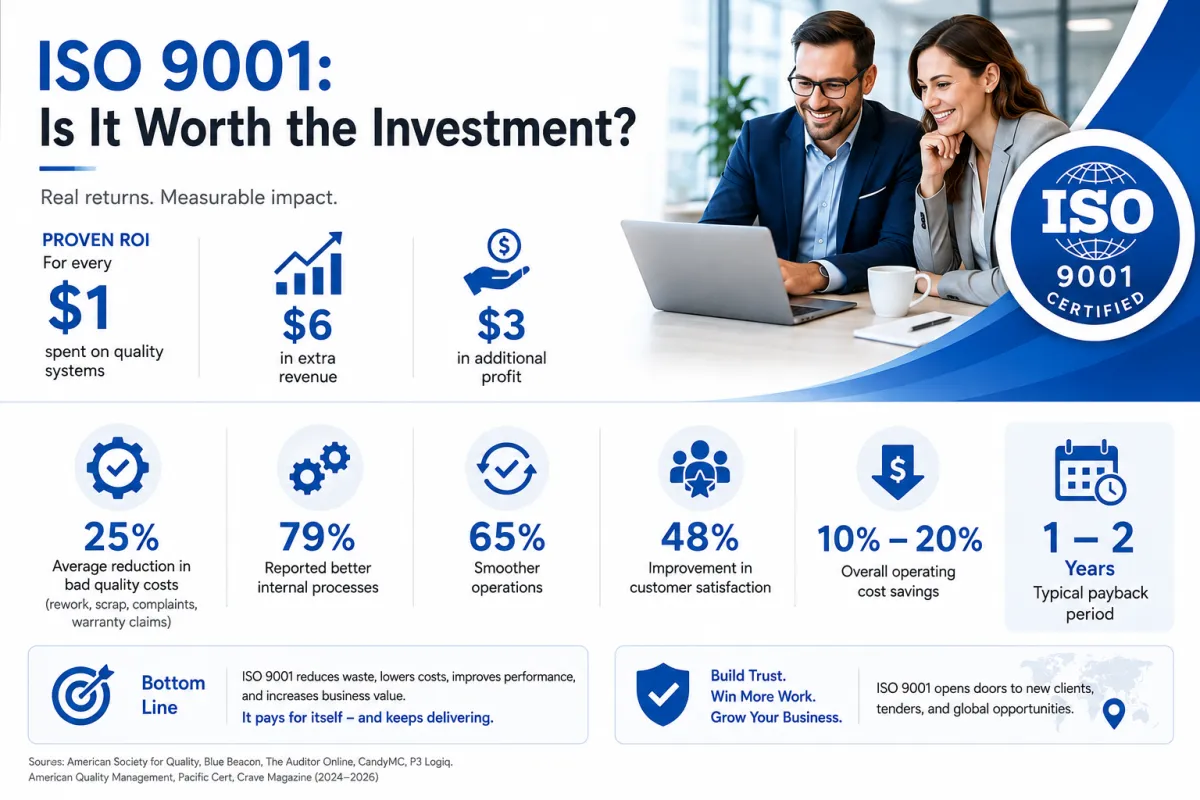
Research from the American Society for Quality found that for every $1 spent on quality systems, businesses earn back $6 in extra revenue, save $16 in costs, and generate $3 in additional profit. That is a strong return by any measure.
Errors and waste drop significantly too. Certified companies cut their bad quality costs, including rework, scrap, customer complaints, and warranty claims, by an average of 25%.
Process control also improves across the board. In one large industry survey, 79% of certified companies reported better internal processes, 65% said their operations ran more smoothly, and 48% saw measurable improvements in customer satisfaction.
On overall running costs, businesses typically achieve savings of between 10% and 20% once ISO processes are properly embedded into daily operations.
In short, ISO certified businesses do more with less and their customers notice the difference.
Hypothesis 2: Does ISO Increase Company Value?
There is no fixed formula that says spend $10,000 on ISO and your business value triples overnight. That kind of simple multiplier does not exist in published research.
What the data does show is a clear financial return. Every $1 invested can return $6 in revenue and $3 in profit. A $10,000 ISO investment could therefore generate roughly $60,000 in additional revenue and $30,000 in extra profit over time.
Higher and more consistent profit directly feeds into a higher business valuation. Buyers and investors pay a premium for businesses that operate reliably, carry lower risk, and have documented, repeatable systems in place. ISO certification signals all of those things.
Certification also unlocks new revenue opportunities. Many government tenders, corporate supply chains, and international contracts require ISO certification as a baseline condition just to be considered.
In short, ISO does not just make a business run better. It makes the business worth more.
Hypothesis 3: How Long Before You Break Even?
The payback period depends on the size of the company and how seriously the standard is applied in practice.
With quality related cost savings typically ranging between 3.5% and 25%, most small and medium sized businesses recover their full certification and audit costs within one to two years. Larger companies, where the dollar value of inefficiencies is bigger, often break even faster.
The key variable is implementation. Companies that treat ISO as a genuine operating system, rather than a paperwork exercise, see results far sooner than those that go through the motions.
In short, for most businesses, ISO pays for itself well within two years and keeps delivering returns long after that.
Conclusion ...
ISO 9001 is not a bureaucratic hurdle. It is a business investment with measurable, documented returns.
It reduces waste. It lowers costs. It improves how a business is perceived by customers, partners, and investors. And in most cases, it pays for itself within one to two years.
For any business serious about growing sustainably, winning better clients, and building a more valuable operation, the question is not whether ISO is worth it. The question is why wait any longer.
To find out what ISO certification could mean for your business specifically, visit Trans4m Business Consulting at https://www.t4m.com.au/iso-consulting
Learn more at ISO Aligned Processes
