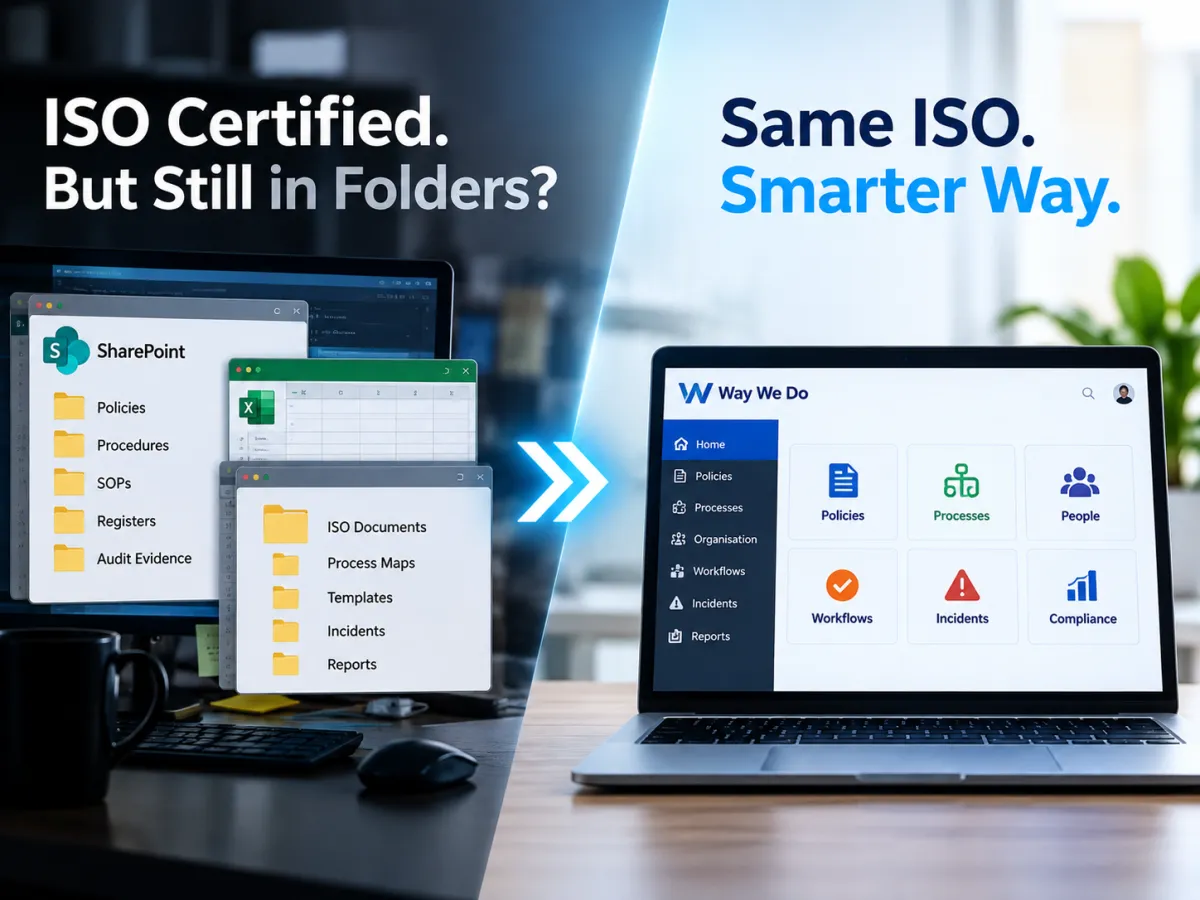
ISO Certified, But Is Your ISO Management System Still Sitting in Folders?
ISO Certified — But Is Your ISO Management System Still Sitting in Folders?
You have achieved ISO certification. But has ISO become part of how your business actually operates every day?
Many ISO-certified businesses are already digital.
There is no paperwork.
Policies are on SharePoint.
SOPs are saved in folders.
Registers are maintained in Excel.
Incident logs sit in another spreadsheet.
Organisation charts are stored somewhere else.
Audit evidence is spread across Teams, SharePoint, emails and different folders.
So, technically, everything is digital.
But is it integrated?
That is the real question.
The Problem Is Not Paper. It Is Fragmentation.
Having ISO documents in SharePoint does not automatically make your ISO management system part of daily operations.
Think about your business.
When someone starts a process, do they automatically know which procedure applies?
Does the system know who is responsible?
Can you see whether the required steps were completed?
If an incident occurs, does it connect to the relevant process and corrective action?
Can management see compliance in real time?
Or does someone still have to open folders, update spreadsheets, send reminders and collect evidence?
If so, your ISO system may be digital but still manual.
And that creates additional work.
What If ISO Was Embedded Into Daily Work?
This is where an Integrated Digital Management System can change the approach.
Instead of treating ISO as a separate compliance folder, policies and procedures can become part of the way employees actually perform their work.
Platforms such as Way We Do are designed to turn documented procedures into active workflows. Tasks can be assigned to roles, completion can be tracked, and processes can be embedded into day-to-day operations. Way We Do
The difference is important.
A document tells someone what should happen.
An activated workflow helps make it happen.
Connect People, Policies and Processes
Imagine bringing together:
Organisation Structure → Policies → Processes → Responsibilities → Workflows → Incidents → Evidence
Your organisational structure identifies responsibility.
Your policies establish requirements.
Your processes explain what needs to happen.
Workflows guide employees through the required steps.
Incidents can trigger actions.
Completion records provide evidence.
Way We Do, for example, supports activated workflows with assigned roles, reminders and completion tracking. It can also maintain procedure history and evidence of process adoption, supporting ongoing audit readiness.
Now ISO is no longer sitting beside the business.
It becomes part of the business.
Stop Rebuilding the Evidence Before Every Audit
Ask yourself what happens before your next ISO audit.
Does someone start checking SharePoint?
Chasing process owners?
Updating Excel registers?
Finding evidence?
Confirming procedures were followed?
Imagine instead being able to demonstrate:
Here is the process.
Here is the owner.
Here is who completed it.
Here is when it happened.
Here is the evidence.
Here is the incident and corrective action.
That is a very different approach to ISO management.
The platform can track process completion, approvals and evidence as work happens, creating an ongoing audit trail rather than relying solely on retrospective evidence gathering.
You Already Have ISO. Now Make It Work Harder
You have invested significant effort in achieving certification.
The next step may not be creating more documents.
It may be integrating what you already have.
Less searching.
Less duplication.
Less manual follow-up.
Better accountability.
Better visibility.
And a management system that supports everyday operations—not just the next audit.
Already ISO certified but managing your ISO system through SharePoint, folders and Excel?
Trans4m Business Consulting can help you move towards an Integrated Digital Management System, embedding your policies, processes, responsibilities and compliance activities into day-to-day operations.
Learn more at ISO Readiness
