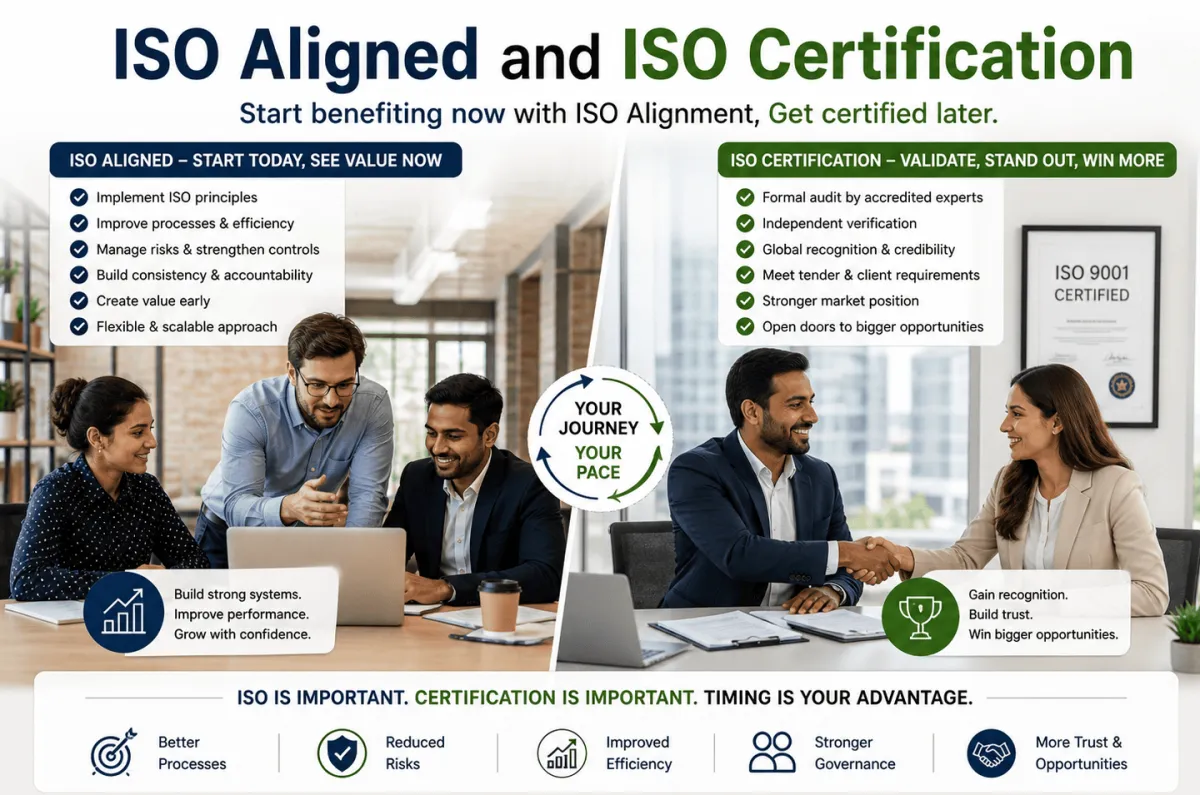
ISO Aligned and ISO-Certified
You Can Start Benefiting from ISO Immediately, Certification Can Follow
When many business owners hear the word ISO, they immediately think of expensive audits, complex paperwork, and a long certification process. That assumption often causes SMEs, founders, and growing businesses to delay action.
But here is the truth:
You can defer certification and start benefiting from ISO.
In fact, some of the biggest operational gains come immediately after alignment
ISO is not just a Certificate ... Its ancultural change
ISO standards are globally recognised frameworks designed to help businesses run better. They improve how your company manages quality, risks, customer service, security, and internal operations.
The real impact comes from the way your business operates every day; with clear processes, defined responsibilities, consistent delivery, and strong governance. That’s what drives efficiency, scalability, and trust.
Certification then becomes a powerful validation of that foundation.
This means you don’t have to do everything at once.
You can start by building an ISO-aligned business, embedding the right systems, processes, and controls — and begin seeing immediate operational benefits. As your business grows and the need arises (tenders, enterprise clients, investor readiness), you can move towards certification with confidence.
In simple terms:
ISO alignment builds capability
Certification amplifies credibility
What Is an ISO-Aligned Approach?
An ISO-aligned business uses the core principles of ISO standards without immediately going through external certification. This may include:
Documented processes and procedures
Clear responsibilities and accountability
Risk management practices
Better customer service systems
Performance measurement and reviews
Continuous improvement culture
Stronger governance and controls
This gives your business structure, consistency, and scalability without the upfront pressure of formal audits.
Why This Works Well for SMEs and Founders ...
For smaller businesses, every dollar matters. You need to weigh cost vs value carefully.
Going straight to certification may not always be the smartest first step. Instead, businesses can:
1. Improve Operations First: Fix inefficiencies, remove bottlenecks, and build smoother workflows before paying for certification.
2. Build Confidence Gradually: Your team gets used to systems and accountability before a formal audit process.
3. Certify When It Creates Commercial Value: Many businesses choose certification when they need it for:
Government tenders
Corporate supplier requirements
Investor due diligence
International partnerships
Market credibility
That means certification becomes a strategic investment, not just an expense.
ISO Aligned and Certified: What’s the Difference?
ISO Aligned
Your business adopts ISO principles internally. Best for:
Startups
SMEs
Fast-growing businesses
Founder-led companies
Businesses wanting better structure first
ISO Certified
An accredited external body audits and certifies your system. Best for:
Tender opportunities
Enterprise clients
Regulated industries
Businesses seeking market differentiation
Both paths create value. The difference is timing and purpose.
The Smarter Option: A Phased ISO Journey
Rather than treating ISO as one giant project, think of it as a roadmap.
Phase 1 Discovery: Review your current processes, risks, and business goals.
Phase 2 ISO Alignment: Implement practical systems, procedures, controls, and governance.
Phase 3 Optimise: Use the framework to improve efficiency, customer experience, and leadership reporting.
Phase 4 Certify (When Ready): Undertake certification once there is a clear commercial reason.
This phased journey reduces stress, controls cost, and delivers value earlier.
Why Waiting Can Cost More
Many businesses delay ISO until a tender appears or a major client asks for it. Then they rush the process under pressure. That often means:
Higher consulting costs
Internal disruption
Poor staff buy-in
Missed deadlines
Reactive decisions
A proactive roadmap avoids that trap.
Final Thought ...
ISO should not be seen as an all-or-nothing decision.
You will see the benefits prior to certification.
Start by becoming ISO-aligned, improve the way your business runs, and certify when it supports growth.
That is the smarter path.
If you are an SME, founder, or growing business wondering where to start, begin with a simple ISO Discovery Session. Understand your gaps. Build a practical roadmap. Unlock benefits now and certify later when the timing is right.
Learn more at ISO Aligned Processes
